

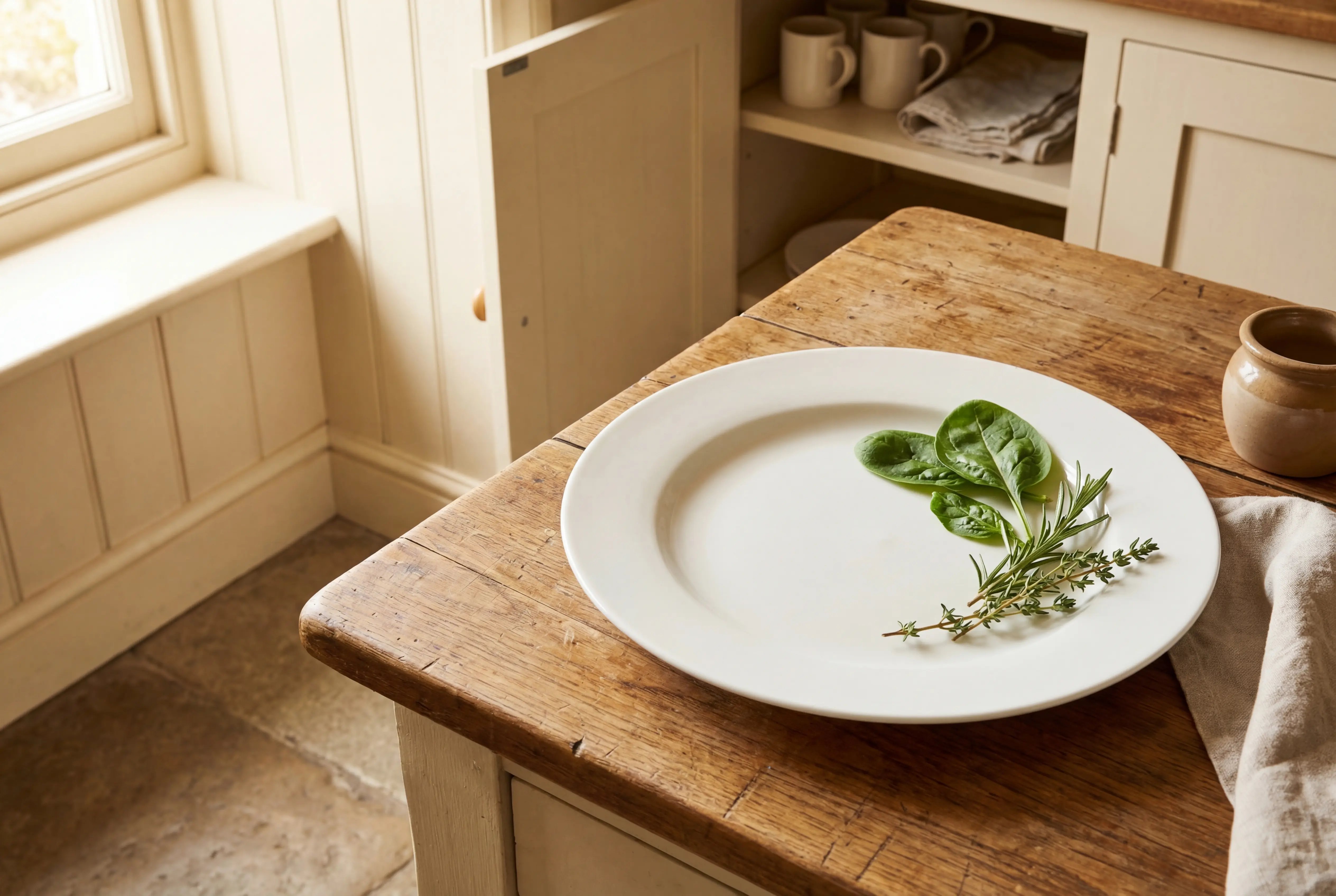


It's 6pm and you've just unloaded the dishwasher.
The plates are warm, the glasses are clear, and you're spooning pasta onto a bowl for your kid without a second thought.
The machine ran, the cycle finished and everything looked clean.
That's the 'Clean Plate Assumption' and most households in the UK are making it every single day.
Modern dishwasher detergents are formulated with ingredients specifically designed to cling to surfaces.
Rinse aids coat glassware with a thin film that makes water bead and run off, surfactants stay active at extreme dilutions and certain fragrance compounds and preservatives don't disappear when the cycle ends. That's all by design.
The industry calls it surface deposition, and the point is that something stays behind because that's what makes cutlery dry streak-free and glasses sparkle.
Scientists have tested dishes from domestic dishwashers after a full cycle and found detergent compounds still present.
A field study published in the European Journal of Public Health reported detectable detergent on 13% of dishes and 33% of glasses after a normal wash.
A standard cycle in a standard home, on plates you'd serve dinner on an hour later.
The question isn't just what's on the plate. It's what gets into the food you put on it, and from there, into the people eating it.

A standard family dinner — most plates still carry detergent residue from the last wash cycle
What's Actually Left on Your Dishes
Alcohol Ethoxylates
These are the cleaning agents found in most mainstream tablets and rinse aids. Although they shift grease well, research suggests they don't always fully rinse away.
A 2023 study found they can damage the lining of the gut at extremely low concentrations, the kind that could plausibly remain on a dry plate after a wash cycle. That gut lining is what separates what you've eaten from your bloodstream. When it's repeatedly disrupted, it becomes less effective at doing that job.
Your family eats off those plates up to 3 times every day.
Phthalates
If your tablet has a fragrance, it almost certainly contains phthalates. These are the chemicals used to make scent last, and several have been flagged by European regulators as hormone disruptors. They won't appear on the label by name. They're buried under the word "parfum," which can legally cover hundreds of individual chemicals.
They don't only end up on your plates either. Open the dishwasher after a hot cycle and you're breathing what the detergent released into the steam. The exposure happens at the sink, not just at the dinner table.
1,4-Dioxane
This is classified as a probable human carcinogen. No brand adds this deliberately but it forms as a by-product during manufacturing and ends up in the finished product as a contaminant. New York State capped it in household cleaners in 2023 but the UK has no equivalent rule.
Skin-Sensitising Preservatives
Two preservatives called MI and BIT show up in UK rinse aids and some tablets. The EU has restricted them so heavily in cosmetics that they're effectively off-limits in most personal care products, because of a documented rise in skin reactions and allergies. Those same restrictions don't apply to dishwasher products.
Research tracking allergy trends found sensitisation to these compounds rose substantially between 2014 and 2023, with cleaning products identified as a primary source.
Fragrance Allergens
Common fragrance compounds appear in mainstream tablets and in several eco-positioned ones too. For anyone managing skin sensitivities, or managing them in their children, "eco" on the label doesn't automatically mean these aren't in the formula.
Why the Dishwasher Matters
With the dishwasher, the exposure route is about as direct as it gets.
Food sits on your plates, drink goes in your glasses and toddlers hold spoons in their mouths between bites. Whatever residue remained after the last wash cycle has a clear, short path into the body.
Children are not small adults when it comes to chemical exposure. They eat and drink more per kilogram of body weight than adults and their gut lining is still developing. Their systems for metabolising and clearing foreign compounds are less mature and because they eat on those plates up to three times a day, the exposure is cumulative in a way that a single incident isn't.
Most parents spend considerable time thinking about what goes into their child's food but very few think about what's on the surface it's served on.

Children eat and drink more per kilogram of body weight — their exposure to residue is proportionally higher
Who's Most Affected
Anyone managing gut sensitivities, IBS, or unexplained digestive symptoms, because their gut lining may already be struggling and repeated low-level exposure doesn't help it recover.
Women going through perimenopause, because their hormonal balance is already shifting and the last thing they need is daily contact with compounds linked to endocrine disruption.
And honestly, anyone who's been eating off the same plates for years and never considered what the rinse cycle does and doesn't remove.
Children are part of this too but this isn't just a children's issue. It's a whole household one.
What to Look for Instead
 No alcohol ethoxylates. These are the cleaning agents linked to gut lining damage in the research, and they're in most mainstream and even eco tablets without any mention on the packaging.
 No hormone disruptors in fragrance. If a product has a scent and can't tell you exactly what's in it, that's a problem. Look for either fragrance-free or a brand that publishes every fragrance ingredient.
 No MI or BIT preservatives. These are the preservatives linked to rising allergy rates across the UK. The EU banned them from most personal care products for exactly that reason. They're still legal in dishwasher products.
 No 1,4-dioxane. It's a contaminant that forms during manufacturing, so it won't appear on any label. The only way a brand can say it's not in their product is if they've specifically tested for it.
 Full ingredient transparency. If a brand makes you dig to find out what's in their product, that tells you something. A brand with nothing to hide makes it easy to find.
 How We Tested
We reviewed 12 of the most widely available non-toxic dishwasher products in the UK, assessing each across five criteria: cleaning performance — grease, egg, tea, red wine, and dried food on standard glassware and crockery — ingredient safety — checked against publicly available ingredient disclosures — ease of use, value per wash, and packaging. Three products stood out clearly from the rest.
The 3 Best Non-Toxic Dishwasher Detergents in the UK
 1
1 Best Overall
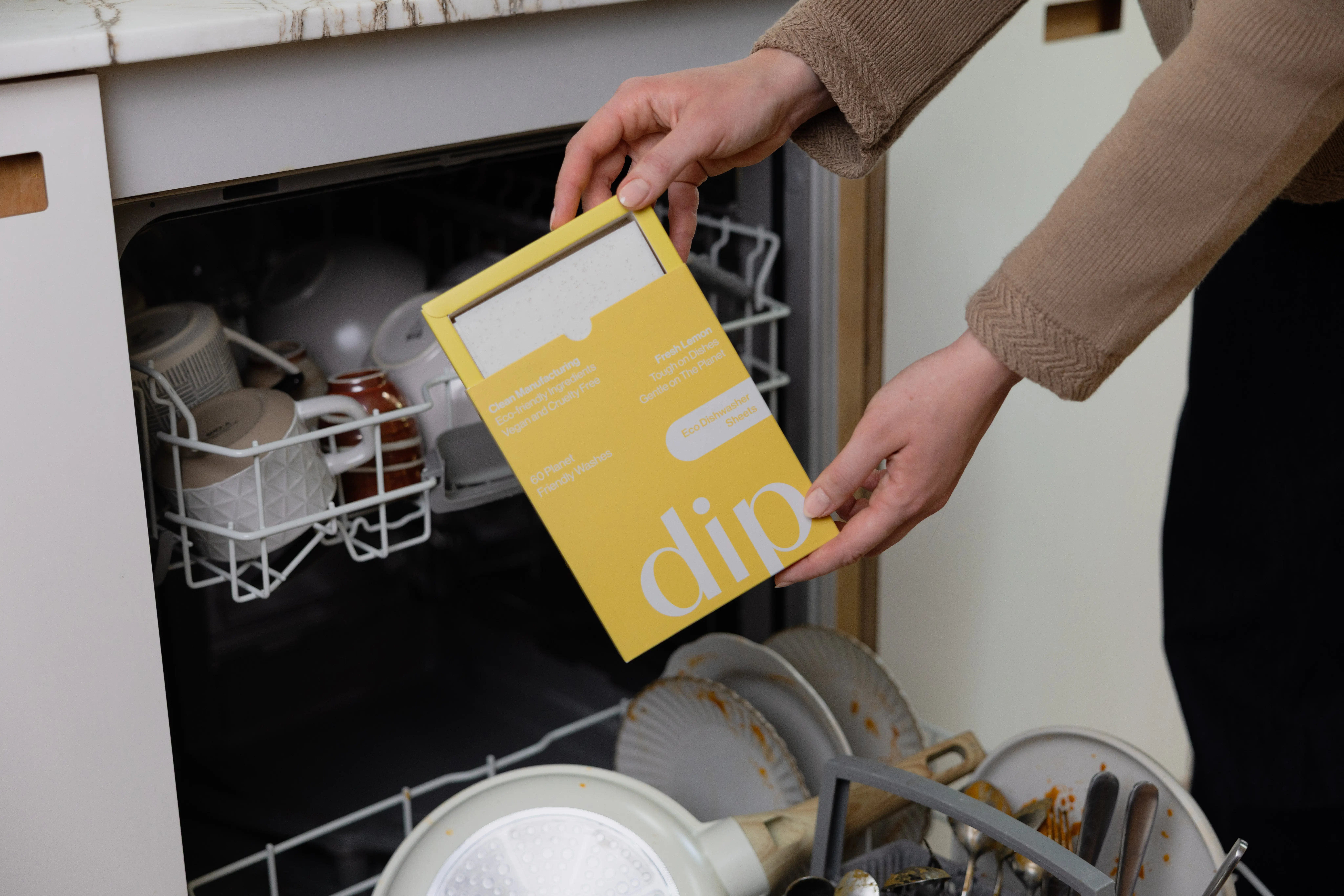
Dip Dishwasher Sheets

 No alcohol ethoxylates, phthalates, or 1,4-dioxane
- ECHA-compliant fragrance (no listed hormone disruptors)
- 2-in-1: dishwasher and handwashing/pre-soak

After putting 12 non-toxic dishwasher products through our full testing process, Dip came out on top, and not just on cleaning performance.
Dip is a dishwasher sheet: a pre-measured, concentrated strip that you fold and place in the tablet slot. No plastic pouch, no measuring, no mess. Tear it in half for a regular load, use a full sheet for a packed one. It dissolves completely in the cycle and leaves no residue coating on dishes or glassware.
On cleaning, Dip matched or outperformed every other product we tested. Grease lifted cleanly across test cycles. Egg residue and dried food shifted without pre-rinsing. Glassware came out clear and streak-free consistently across the test set. The 2-in-1 formula handles both dishwasher cycles and handwashing tasks like pre-soaking baking trays, which means one product replaces what most households currently keep as two or three separate items under the sink.
But it's the ingredient profile that genuinely sets it apart.
Dip contains no alcohol ethoxylates, no phthalates, no 1,4-dioxane, and none of the gut-disrupting surfactants implicated in the intestinal barrier research. Its fragrance is fully ECHA-compliant, meaning it contains no ingredients listed as known hormone disruptors. Most UK dishwasher products, including several marketed as eco-friendly, don't meet that standard. Dip also publishes its full ingredient list including what's in the fragrance, which puts it in a small minority of UK cleaning brands.
The packaging is 100% plastic-free cardboard. No PVA pouch wrapping. No single-use plastic. OECD-certified biodegradable. The formula has a pH of 6 to 7, close to neutral water, compared to the pH 9 to 10 typical in mainstream tablets.
Over 30,000 UK families have switched. Health and wellness professionals including biohacker Tim Gray and nutritionist Pippa Campbell recommend it specifically for its clean formula and ingredient transparency. And if for any reason it doesn't work for you, Dip covers every order with a 100% money-back guarantee. No forms, no friction. You either love it or you don't pay for it.
The subscription option brings the price per wash down to a level that competes with most mid-range dishwasher tablets. It arrives through your letterbox. You'll never run out.
 Pros
Pros- No alcohol ethoxylates, phthalates, or 1,4-dioxane
- ECHA-compliant fragrance (no listed hormone disruptors)
- Full ingredient transparency including fragrance
- 2-in-1 formula (dishwasher and handwashing/pre-soak)
- Neutral pH (6–7) vs. pH 9–10 in mainstream tablets
- 100% plastic-free packaging, no PVA pouch
- OECD-certified biodegradable
- 100% money-back guarantee
- Fragrance-free option available
 Cons
Cons Only available online (wearedip.co.uk)
- May need a full sheet for heavily soiled loads or very hard water areas
| Format | Sheets |
| Washes per pack | 60 |
| Price per wash | £0.28 |
| Fragrance options | Fresh Linen / Fragrance Free |
| Subscription | Yes (20% off) |
 An Excellent Choice
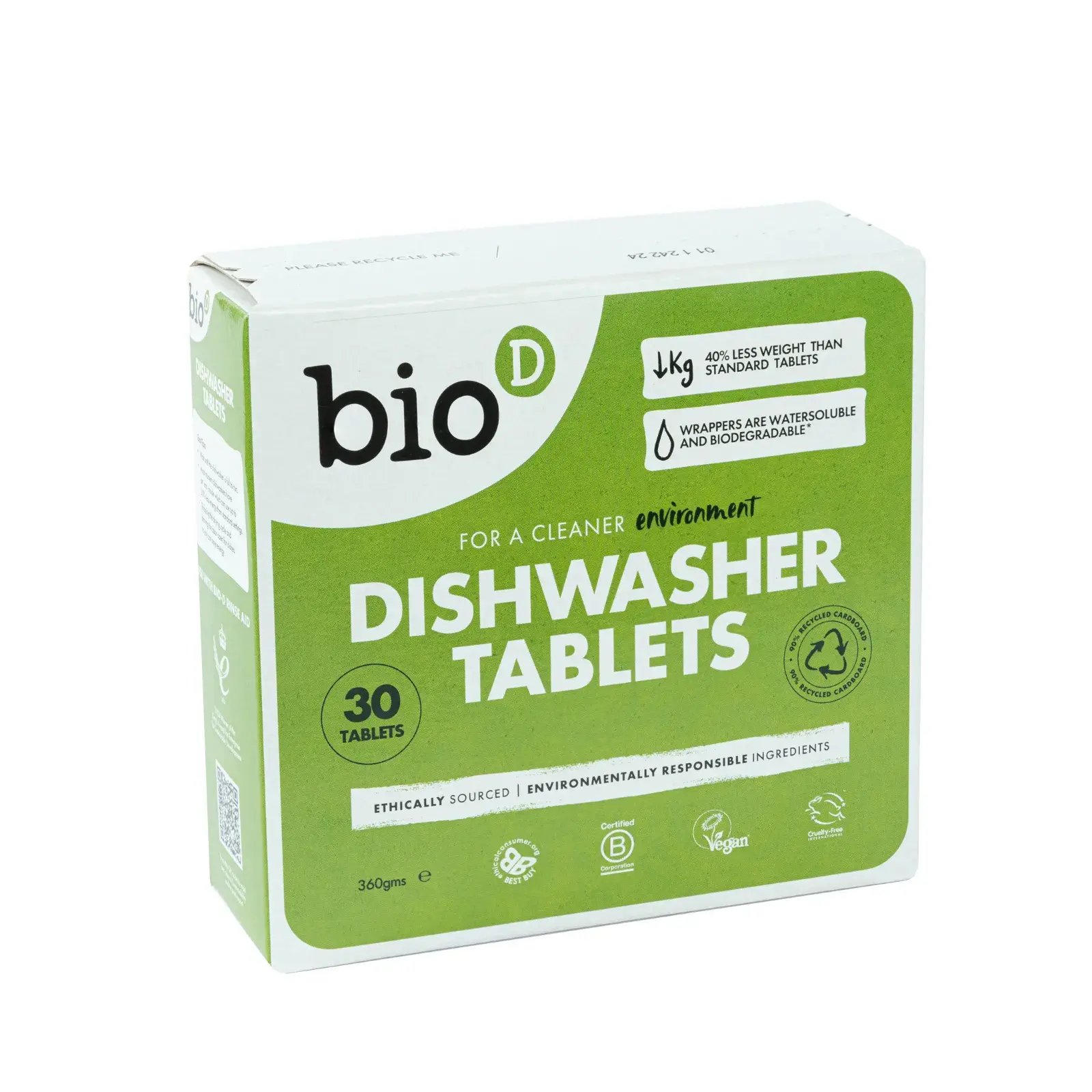
Bio-D Dishwasher Tablets

- Fragrance-free by default
- Honest, straightforward ingredient disclosure
- Genuinely independent UK brand
Bio-D is one of the more genuinely principled brands in the UK eco cleaning space, and its dishwasher tablets reflect that.
Fragrance-free by default, which removes an entire category of concern in one go. Cleaning performance on everyday soils was consistent across our test rounds, and the brand is straightforward about what's in the product, listing ingredient classes clearly on its UK product page and explaining that the tablet wrapper is PVA film independently verified to meet biodegradability standards.
Where Bio-D fell short was depth of transparency and ingredient profile. The disclosure lists ingredient classes rather than specific compounds, so you know there are nonionic surfactants and oxygen bleaching agents, but not which ones. That matters if the specific surfactant class is what you're trying to avoid. The PVA wrapper is also present, and while Bio-D is upfront about it, the scientific debate on PVA's downstream environmental fate is still active. On tougher soils, grease and dried-on food in particular, it needed more cycles than Dip to clear cleanly.
For anyone whose primary concern is fragrance and preservatives, Bio-D is a strong, honest choice. For anyone whose primary concern is alcohol ethoxylates and full compound-level transparency, the gap between Bio-D and Dip is meaningful.
Pros- Fragrance-free by default
- No added perfume allergens or preservative concerns
- Honest, straightforward ingredient disclosure
- Independent biodegradability verification on PVA wrapper
- Genuinely independent brand
Cons- Ingredient classes listed, not specific compounds
- PVA film on tablet
- Inconsistent on tougher soils
- Less widely available than Ecover or Smol
| Format | Tablets |
| Washes per pack | 30 |
| Price per wash | £0.24 |
| Fragrance options | Fragrance Free only |
| Subscription | No |
 3
3 A Solid Option
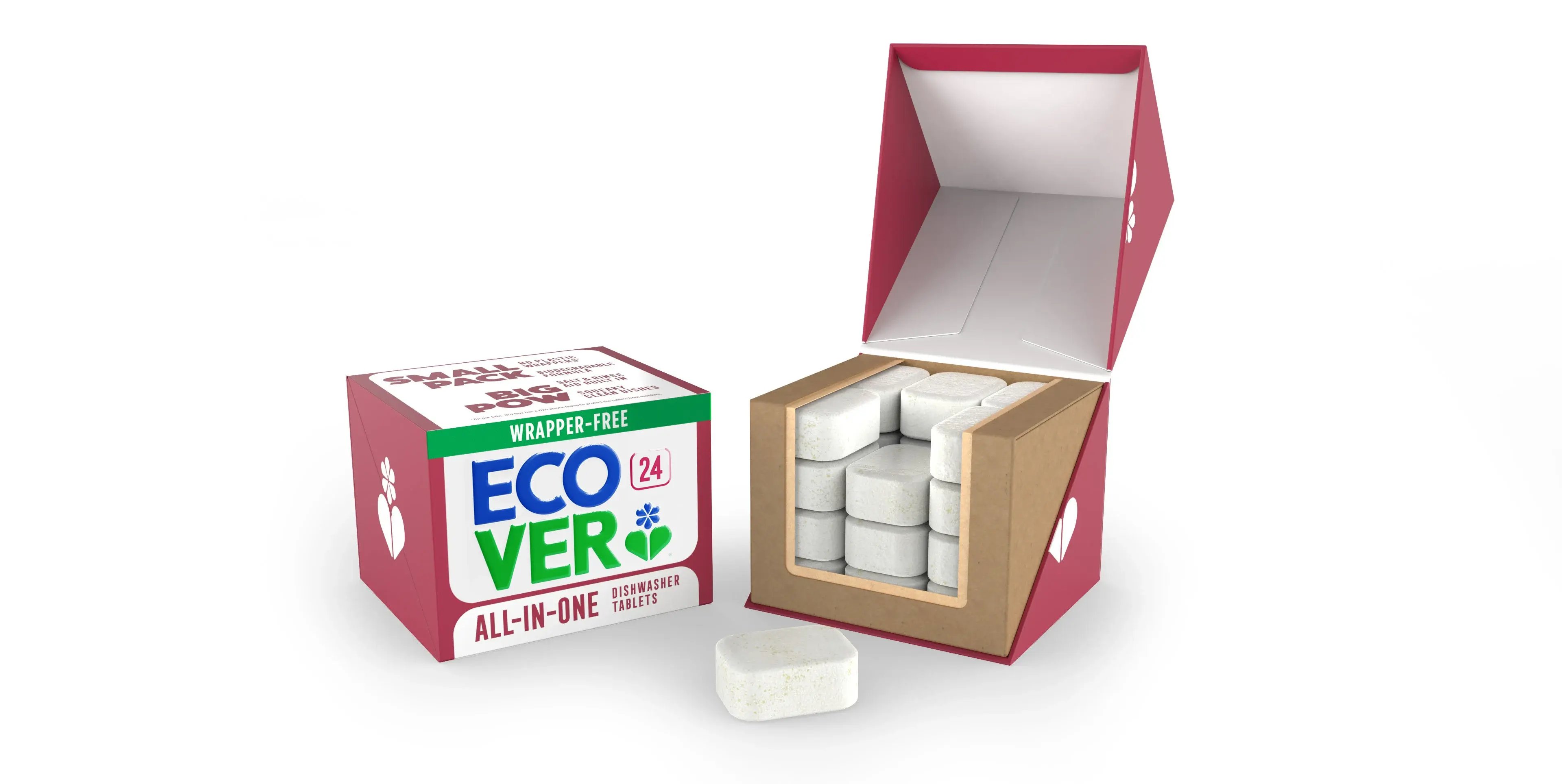
Ecover All-in-One Dishwasher Tablets
- Consistent everyday performance and colour retention
- Full ingredient list publicly available
- Widely stocked in UK supermarkets
Ecover is one of the most recognisable names in eco-friendly cleaning, and its All-in-One dishwasher tablets performed consistently on colour retention and everyday soils across our test rounds. The brand publishes a full ingredient list on its UK product page and links to the EU database, making it one of the more transparent eco brands available in UK supermarkets. The formula is plant-derived, it holds recognisable eco certifications, and its wide availability is a genuine practical advantage.
Where it fell short was ingredients. The published list includes TAED and sodium carbonate peroxide as the bleach system, nonionic surfactants including PEG derivatives, parfum, fragrance allergens including limonene, and polyvinyl alcohol. On tougher soils, particularly egg and dried food, it required pre-rinsing in most test rounds where Dip did not.
It's also worth noting that Ecover's separate stain remover product has been listed by multiple UK retailers as containing methylisothiazolinone. That's not the dishwasher tablet, but for anyone actively managing MI sensitivity across their full cleaning routine, it's a relevant signal about how the wider range is formulated.
Ecover is a solid entry point for people moving away from mainstream brands. It's not the cleanest on ingredients, but it's meaningfully better than most of what's on supermarket shelves.
Pros- Consistent everyday performance and colour retention
- Full ingredient list publicly available
- Plant-derived formula
- Widely stocked in UK supermarkets
Cons- Contains fragrance allergens (limonene listed)
- PVA film on tablet
- Pre-rinsing often needed on tougher soils
- MI present in separate Ecover stain remover
- Owned by SC Johnson
| Format | Tablets |
| Washes per pack | 24 |
| Price per wash | £0.22 |
| Fragrance options | Scented / Fragrance Free |
| Subscription | Amazon only (5% off) |
Quick Comparison
See how our top picks stack up against each other
| Feature | Dip Sheets | Bio-D Tablets | Ecover All-in-One |
|---|---|---|---|
| Price per wash | £0.28 | £0.24 | £0.22 |
| Format | Dissolvable sheet | Tablet | Tablet |
| No Alcohol Ethoxylates | |  | |
| No Phthalates | | | |
| ECHA-Compliant Fragrance | | | |
| Full Ingredient Transparency | | | |
| Plastic-Free | | | |
| Money-Back Guarantee | | | |
| Best for | Clean-formula families | Fragrance-free priority | Budget entry point |
Why Dip Is Our #1 Pick
Every other product we tested had at least one meaningful compromise.
Bio-D is honest and fragrance-free but can't tell you which surfactant class is in the formula. Ecover publishes a full ingredient list but it includes fragrance allergens, PVA film, and a bleach activator system. Dip had none of those compromises.
It's the only product on this list with no alcohol ethoxylates, fully ECHA-compliant fragrance, complete compound-level ingredient transparency, plastic-free packaging without a PVA pouch, neutral pH, and a money-back guarantee, all at a price per wash that's within 2p of the big supermarket brands.
For anyone who has decided that what sits on their family's plates between cycles deserves the same scrutiny as what goes on them, Dip is the most complete answer we found.
Conclusion
The research is clear: dishwashers rinse, but they don't necessarily rinse everything away.
Detergent compounds can be detected on dishes and glasses after a full cycle. Cleaning agents in rinse aids have been shown in laboratory research to damage the gut lining at extremely low concentrations. Preservatives linked to rising allergy rates appear in mainstream rinse aids sold in UK supermarkets today. And for families eating three meals a day off those dishes, the exposure accumulates in ways that the product marketing never mentions.
The good news is that switching is easy. One product, one order. And if it doesn't work for you, you get your money back.
30,000 UK families have already made the switch. Most say the only thing they regret is not doing it sooner.
Ready to Make the Switch?
Join 30,000+ UK families who've swapped hidden chemicals for cleaner, safer dishes — without sacrificing a single ounce of cleaning power.
Shop Dip Dishwasher Sheets — Currently Discounted
All products backed by a 100% money-back guarantee
Disclaimer: This is an advertorial. While we believe the information provided is accurate to the best of our knowledge, it is not a news article, clinical report, or consumer protection publication.